
Lead qualification from chat: questions, stages and follow-up
Lead qualification from chat means working out, from the customer’s own messages, whether they are a serious buyer, what they need and when, then putting them in a clear stage your team follows up. Good qualification happens inside the conversation, with a few natural questions, not with a long form before the answer.
This article covers the questions that qualify a customer without annoying them, the stages that are enough for most businesses, the signals of interest in a conversation, the rules of follow-up, and what Mujib does about all of it automatically.
What does qualifying a lead in a chat mean?
Section titled “What does qualifying a lead in a chat mean?”Qualifying a customer means deciding, from what the person writes, how much of your team’s time they deserve and what the next step with them is. Not everyone who asks the price is ready to buy, and not everyone who writes a short message is uninterested.
The advantage of a chat is that the signals are written down in front of you: did they ask about one service or about everything? Did they ask for a slot, or ask in general? Did they reply within minutes or days later? Did they give their name and number? All of this qualifies the customer before you ask a single question.
Which questions qualify a customer without annoying them?
Section titled “Which questions qualify a customer without annoying them?”The questions your business needs answered to actually serve the customer: what they want, when, where, and for whom. A question that serves the customer does not feel like an interrogation; it feels like a step towards what they asked for.
| Question | What it reveals | Example |
|---|---|---|
| What exactly do you need? | The right service | “Would you like a cleaning session, or a consultation first?” |
| When would you like to start? | How serious and urgent they are | “Does this week suit you?” |
| Which branch is closer to you? | The branch responsible for them | “We have two branches, which one is nearer?” |
| Is the appointment for you or someone else? | Who decides and who comes | “Shall I book it in your name?” |
| Shall I book you a slot? | Readiness for the next step | “We have a free slot tomorrow evening” |
Rules that keep these questions comfortable:
- Answer first. Someone who asked the price gets the price, then your question.
- One question per message. Three questions at once read like a form.
- Do not ask what you know. If they named the branch in their first message, do not ask again.
- Offer options instead of asking the budget. Their pick between two priced options tells you what you need without embarrassment.
- Respect people who are only asking. “Just asking for later” is a fine answer; note it and let it be.
What are the stages of a lead?
Section titled “What are the stages of a lead?”Five stages are enough for most service businesses: new, engaged, qualified, won and lost. Many stages look precise, but the team stops updating them.
| Stage | What it means | What moves the customer there |
|---|---|---|
| New | The first message arrived | An opening message with no clear intent yet |
| Engaged | Actually talking | Several messages, follow-up questions |
| Qualified | Interested in a specific service | Asking its price or a slot, or strong engagement |
| Won | Committed | Booked an appointment or placed an order |
| Lost | No longer interested | Said they are not interested, cancelled, or asked not to be contacted |
Make moving forward easy, and moving back a deliberate decision. A customer who booked and then cancelled one appointment does not become “new” again.
How do you tell that a lead is serious?
Section titled “How do you tell that a lead is serious?”You tell from several signals together, not from one. A fixed rule is fairer than an impression, because it treats every customer the same way:
- Depth of engagement: every extra message from the customer signals interest, but each is worth less after the first few.
- Recency: someone who wrote today is warmer than someone who wrote two weeks ago, and interest cools with time.
- Outcome: a booking or an order is the strongest signal; asking about a specific service is a medium one.
- Reachability: a customer who left their name and number is easier to follow up.
- Negative signals: “not interested”, a cancellation, or spam lower the rating however much they engaged.
Combine these signals into one score, then split it into three bands: cold, warm and hot. A small team starts with the hot ones every morning.
When should you follow up with a lead, and when should you let go?
Section titled “When should you follow up with a lead, and when should you let go?”Follow up with an interested customer when they go quiet, and stop when they say they are not interested or ask you not to message them. A good follow-up carries something new and useful:
- Add information: “Following up on your question, there is a slot on Thursday” works better than “Are you still interested?”.
- One or two follow-ups: after that, leave the door open and do not repeat.
- Respect the channel’s limits: on Messenger and Instagram, Meta does not accept a standard reply once 24 hours have passed since the customer’s last message, as the Messenger Platform policy explains. See The 24-hour window.
- Make someone responsible: a customer nobody on your team owns is a customer nobody follows up. Assign the conversation to a person, as in Assign conversations.
How does Mujib qualify leads from chat?
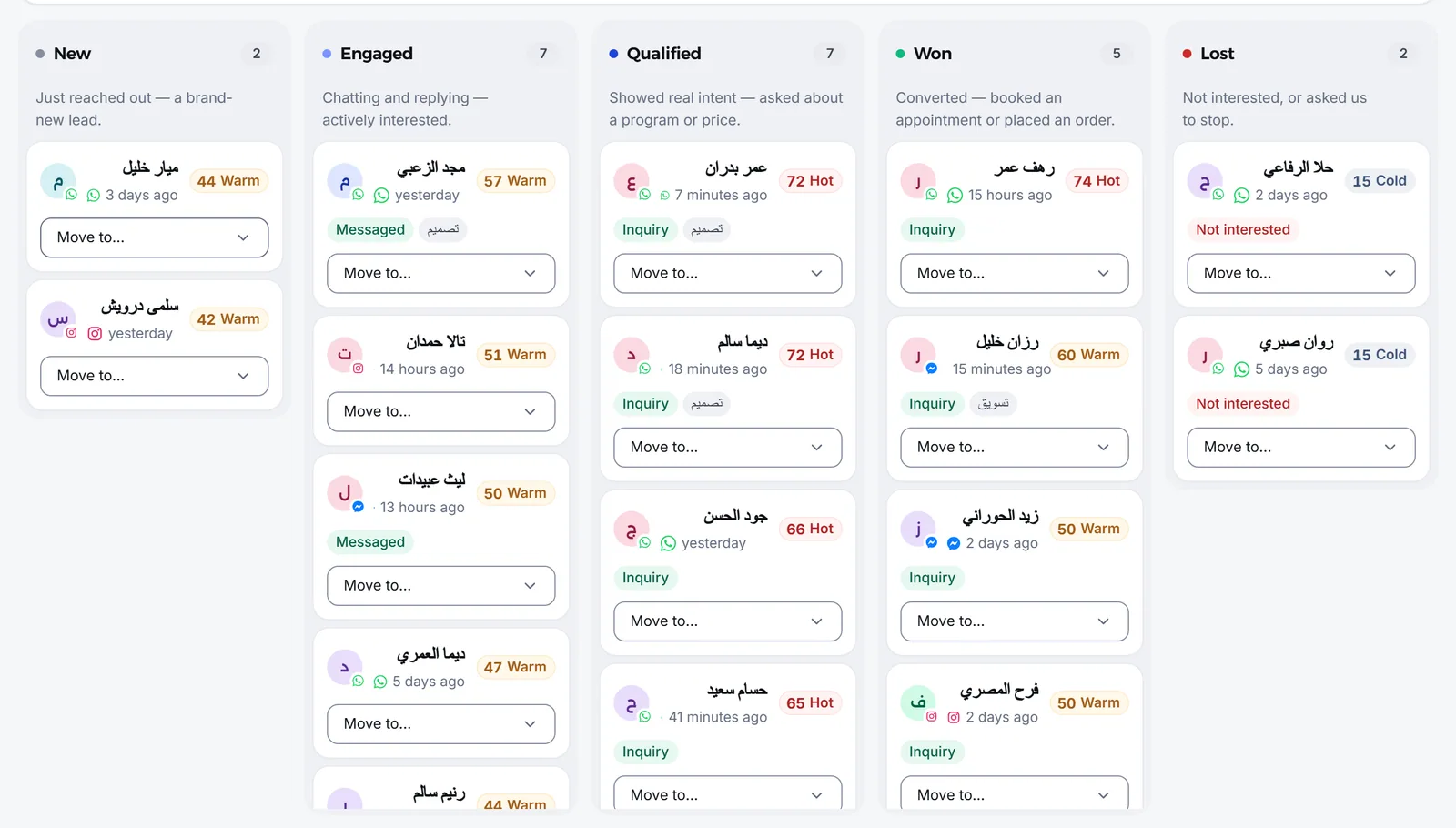
Section titled “How does Mujib qualify leads from chat?”Mujib puts every customer who messages you on the Leads page with a stage and a Lead score, and updates both automatically from the conversation itself. The full details are in Leads.
- Stages: New, Engaged, Qualified, Won and Lost. Mujib promotes the customer automatically as they engage, a booking or an order wins them, and it never moves them down. It moves them to Lost if they say they are not interested, cancel, or are marked as spam; a won customer, though, is only lost when marked as spam or asking not to be contacted.
- Score: calculated by fixed rules from engagement, recency, outcome and reachability, and split into Cold, Warm and Hot. It uses no AI and none of your allowance.
- Moving by hand: in the Pipeline view, drag a customer’s card to the stage you want.
- Follow-up list: in Analytics you find Needs follow-up: engaged or qualified customers who have been quiet for more than 7 days or never replied. Your team follows them up itself; Mujib sends no follow-up messages on its own.
- Qualifying questions: write in the agent’s instructions what it should ask before booking, as in Agent instructions.
- Handing over: set in When it hands off to staff the cases where the agent passes the customer to your team, such as a request for a special quote. See Human handoff.
You can also ask ChatGPT or Claude which interested customers stopped writing, once you connect them to Mujib, as in Mujib in ChatGPT.
What are the common mistakes in qualifying leads from chat?
Section titled “What are the common mistakes in qualifying leads from chat?”The most common mistake is turning qualification into a wall between the customer and their answer.
- A form before the answer: name, number and city before the customer even knows the price.
- Too many stages: ten stages nobody updates are worse than five clear ones.
- Rating by impression: one employee sees a customer as hot, another as cold, so months cannot be compared.
- Annoying follow-ups: repeated messages with nothing new turn a warm customer into a lost one.
- Nobody responsible: a long follow-up list nobody opens.
Frequently asked questions
How many questions should I ask to qualify a customer?
As few as you need to serve them, namely what they want, when and where. Ask one per message, after you have answered their own question.
Should I ask a customer about their budget directly?
It is better to show the options with their prices and ask which one suits them. Their choice tells you what you need without an awkward question.
When do I count a customer as qualified?
When they show clear interest in a specific service, such as asking its price or a time slot, or asking to book. A customer who actually booked or ordered has moved on to won.
Does Mujib send automatic follow-up messages to customers who stopped replying?
No. Mujib shows you the list of customers who need a follow-up, and your team follows up with them itself.
Does lead scoring in Mujib use up my allowance?
No. Scores and stages are calculated automatically by fixed rules from the customer's behaviour, with no AI and no credit used.